
Judicial Fellowship Programme | Apply Now
Program Overview!
Want hands-on experience at the world’s top international court? The International Court of Justice (ICJ) Judicial Fellowship Programme places a small number of outstanding recent law graduates with Members of the Court in The Hague for a full-time, ~10-month placement (research, drafting, attending hearings). It’s valuable because: 1) you get direct mentorship from an ICJ Judge and exposure to real inter-state litigation and advisory work, 2) it’s a prestigious CV builder widely recognised in international law, and 3) universities nominate candidates (so strong academic records + institutional support are decisive). Note: nominations come from universities — individuals cannot apply directly
The International Court of Justice (ICJ) is the UN’s principal judicial organ, resolving state-to-state disputes and issuing advisory opinions on international law. Based in The Hague, the Court’s Registry supports the work of 15 Judges and their legal teams. The Judicial Fellowship Programme (formerly University Traineeship Programme) brings very capable junior lawyers to work closely with Members of the Court and their legal assistants, strengthening participants’ knowledge of public international law and Court procedures. The Court publishes calls for nominations and maintains forms and guidance for nominating institutions.
Selected Judicial Fellows are placed with an individual Judge (and the Judge’s legal assistant) and carry out legal research, draft memoranda, help manage case files, and may attend hearings. The programme is highly competitive: universities pre-select and nominate a few candidates each year; the Court then makes final selections. Placements usually run from September through June and aim to expose fellows to both contentious cases and advisory proceedings at the ICJ.
Read More – Commonwealth Shared Scholarships | Apply Now
Benefits:
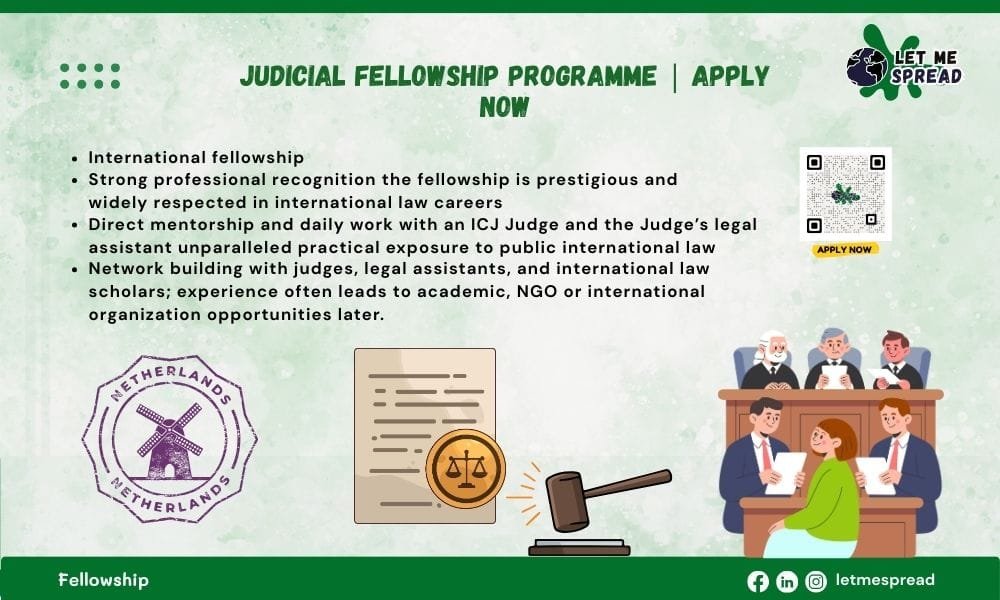
- Direct mentorship and daily work with an ICJ Judge and the Judge’s legal assistant unparalleled practical exposure to public international law.
- Strong professional recognition the fellowship is prestigious and widely respected in international law careers.
- Network building with judges, legal assistants, and international law scholars; experience often leads to academic, NGO or international organization opportunities later.
Read More – Lightning Scholar fellowship | Apply Now
Eligibility Criteria
- Who may be nominated: Usually final-year law students (LL.B, J.D), LLM students, recent law graduates and early-career jurists. Many nominating universities specify that applicants should be finishing their degree at the time of nomination or be recent graduates.
- Age guideline: In practice, candidates are commonly required to be 31 years or younger at the start of the fellowship (some flexibility/waiver possible in exceptional cases) — check the current call.
- Languages: Proficiency in English or French is required (ICJ working languages); knowledge of both is an advantage.
- Academic record & profile: Excellent academic results and demonstrated interest/excellence in public international law; research experience, publications, moot court performance, or relevant internships strengthen an application.
- Other constraints: Candidates already enrolled in the same degree in China or similarly restricted situations may be ineligible for some programmes — always verify specifics on the ICJ call.
Read More – Perry World House Lightning Scholars Fellowship (2026–2027) | Apply Now
Application Process
- University pre-selection / nomination: Candidates do not apply directly to the ICJ. Instead, eligible universities (law schools) pre-select and nominate candidates to the Court following the ICJ’s Call for Nominations. Contact your law school’s careers/graduate office to learn internal deadlines and nomination requirements.
- Complete ICJ forms: Nominating institutions must complete the ICJ Personal History Form and compile supporting documents (transcripts, CV, letters of recommendation, identity documents, proof of language ability, writing sample, etc.). The ICJ provides a Personal History form template on its site.
- Submission by the university: The nominating university sends the complete application package to the ICJ Registry by the date indicated in the Call (many cycles use an early-February deadline for the following academic year). Universities should confirm any additional, institution-specific requirements (some universities run internal selection competitions earlier)
- Selection & notification: The Court reviews nominations and notifies selected candidates via the Registry. Selected fellows should coordinate practical arrangements (travel, visa, accommodation, insurance, and financial support) with their university or sponsor, since the ICJ typically does not arrange these.
About Judicial Fellowship Programme
Want hands-on experience at the world’s top international court? The International Court of Justice (ICJ) Judicial Fellowship Programme places a small number of outstanding recent law graduates with Members of the Court in The Hague for a full-time, ~10-month placement (research, drafting, attending hearings). It’s valuable because: 1) you get direct mentorship from an ICJ Judge and exposure to real inter-state litigation and advisory work, 2) it’s a prestigious CV builder widely recognised in international law, and 3) universities nominate candidates (so strong academic records + institutional support are decisive). Note: nominations come from universities — individuals cannot apply directly
The International Court of Justice (ICJ) is the UN’s principal judicial organ, resolving state-to-state disputes and issuing advisory opinions on international law. Based in The Hague, the Court’s Registry supports the work of 15 Judges and their legal teams. The Judicial Fellowship Programme (formerly University Traineeship Programme) brings very capable junior lawyers to work closely with Members of the Court and their legal assistants, strengthening participants’ knowledge of public international law and Court procedures. The Court publishes calls for nominations and maintains forms and guidance for nominating institutions.
Selected Judicial Fellows are placed with an individual Judge (and the Judge’s legal assistant) and carry out legal research, draft memoranda, help manage case files, and may attend hearings. The programme is highly competitive: universities pre-select and nominate a few candidates each year; the Court then makes final selections. Placements usually run from September through June and aim to expose fellows to both contentious cases and advisory proceedings at the ICJ.
Read More – Vienna BioCenter Summer School research program | Apply Now